
The Cost of Store Disconnection: Why Isolated Retail Systems Undermine Customer Experience and Profitability
Retail leaders have spent years adding systems to solve specific problems. POS platforms process transactions. Inventory systems track stock. Loyalty tools identify repeat customers. Workforce applications schedule staff. Pricing tools manage promotions. Cameras, sensors, shelf technology, and analytics platforms capture what happens inside the store.
Each system may be useful on its own. The cost appears when they do not work together.

Vortex Cloud
Unified real-time dashboard for store operations visibility
Learn More →For many retailers, the store has become a collection of separate tools rather than a connected operating environment. Store teams still need to reconcile reports manually. Head office teams still wait for delayed or incomplete updates. Customers still experience gaps between what the website promises and what the store can actually deliver.
Deloitte has argued that retailers need to move beyond fragmented store systems and toward a connected store operating model. The important point is that the connected store is not one device, one dashboard, or one isolated platform. It is a way of running stores with shared operational context.
That distinction matters for APAC retailers. The practical answer is not necessarily to replace every existing system. In most retail estates, that would be slow, expensive, and disruptive. A more realistic path is to connect operational signals into one trusted layer so teams can see what is happening, prioritise what matters, and act faster.
Store disconnection is now an operating-cost problem
Store disconnection is rarely visible as one large failure. It usually appears as small, repeated gaps in execution. A promotion is configured in one system but not reflected accurately at shelf level. Store teams see stock on paper but cannot find it on the floor. A loyalty campaign drives traffic, but workforce planning does not adjust. An outage interrupts store connectivity, but head office only sees the problem after revenue, service, and reporting are already affected.
These gaps compound. Coresight Research found in its 2025 US study that 88 percent of surveyed retailers were at least slightly challenged across store-related business functions. Only 25 percent reported full visibility into store-related business functions overall. The same research reported that gross sales lost to in-store inefficiency averaged 5.5 percent among surveyed US retailers in selected sectors, while 81 percent reported losing at least 5 percent of operating margin to in-store inefficiencies.
Those Coresight figures are US findings, not Singapore or APAC market statistics. They are still useful because they show the economic logic of store inefficiency: when store execution is unclear, the cost can show up in sales, margin, labour, and customer trust at the same time.
Where disconnected systems create hidden cost
Inventory and availability
Inventory is one of the clearest examples of disconnection. A retailer may have stock data in an ERP system, sales data in the POS, online demand in an e-commerce platform, replenishment rules in another tool, and store-floor observations in staff messages or spreadsheets.
When these signals do not connect, availability becomes harder to manage. Store teams may spend time searching for items that the system says are available but are not on the shelf. Online teams may promise fulfilment from a location that cannot locate stock quickly. Regional managers may see the issue only after customers have already left or orders have failed.
Coresight Research found that 57 percent of surveyed US retailers reported losing at least 6 percent of gross sales from out-of-stocks. This should also be treated as US-based evidence, not an APAC benchmark. The operational lesson is broader: stock visibility is not only about counting units. It is about connecting inventory, store execution, customer demand, and exception handling in time for teams to act.
Pricing and promotion execution
Pricing and promotion errors are another common cost of fragmentation. Campaign teams plan offers. Merchandising teams manage price files. Store teams update labels. POS systems apply transaction logic. E-commerce channels may show a different offer. When those processes are disconnected, customers see inconsistency and staff absorb the pressure.
Coresight Research found that promotion execution errors were the most significant challenge among US-based retailers in the survey, with 39 percent ranking it among their top five challenges. Product pricing errors were the second most widely cited challenge, at 37 percent.
For APAC retailers running frequent campaigns across malls, marketplaces, social commerce, and physical stores, the risk is not only wrong prices. The larger risk is losing confidence in execution. If head office cannot see whether stores have implemented a campaign correctly, leaders are forced to manage by assumption.
Staff tasking and store productivity
Disconnected systems also affect labour. Store associates often become the integration layer between tools. They check one system for inventory, another for customer orders, another for promotions, another for scheduling, and another for task updates. When the store is busy, that context-switching becomes expensive.
The issue is not that staff lack effort. It is that operational context is scattered.
Singapore Retail Industry Digital Plan recognises several capability areas that relate directly to this challenge, including integrated POS, ERP inventory and sales management, in-store analytics, multichannel e-commerce, electronic shelf labels, social commerce tools, and omnichannel retail management. It also describes in-store analytics as a way to gather actionable information about the store environment, including traffic patterns that can support more efficient staff scheduling.
Customer experience across online and offline journeys
Customers do not experience retail systems separately. They experience one brand. If an item is visible online but unavailable in-store, that is a customer experience issue. If a promotion appears in one channel but not at checkout, that is a customer experience issue. If a store associate cannot answer a question because the information sits in another system, that is a customer experience issue.
KPMG and GS1 reported on APAC seamless commerce based on a survey of 7,000 consumers across 14 Asia-Pacific markets. The report concluded that seamless commerce has arrived, that both online and offline channels remain popular across the region, and that traditional retail models are unlikely to meet many current consumer expectations.
This makes system fragmentation more visible to customers. The more shoppers move between physical stores, mobile channels, marketplaces, delivery options, and loyalty journeys, the less tolerance they have for operational gaps behind the scenes.
Management reporting and AI readiness
Disconnected stores also weaken management reporting. Leaders may have dashboards, but dashboards are only useful if the underlying data is timely, consistent, and operationally meaningful.
If inventory, traffic, sales, staff activity, promotions, and network status are measured separately, senior teams can end up with reports that explain what happened after the fact but do not help stores respond in the moment. That becomes a serious limitation as retailers explore AI-assisted operations.
Gartner states that 91 percent of retail IT leaders are prioritising AI as the top technology to implement by 2026. Salesforce MuleSoft provides wider enterprise integration context in its 2025 Connectivity Benchmark Report: surveyed organisations use an average of 897 applications, 45 percent report using 1,000 or more, 66 percent do not provide an integrated user experience across channels, and 95 percent of IT leaders report integration as a hurdle to effective AI implementation.
Those MuleSoft figures are enterprise-wide, not retail-store-specific. The implication for retail is still relevant. AI cannot reliably support store operations if the operational data layer is fragmented, delayed, or inconsistent. Before retailers scale AI use cases, they need clean signals from the store.
Why this matters in Singapore and Southeast Asia
Singapore retailers are already operating in a mixed-channel environment. The Singapore Department of Statistics reported that online retail sales were 15.1 percent of total retail trade sales in May 2026. Excluding motor vehicles, the online proportion was 17.7 percent. Online food and beverage sales were 19.8 percent of total F&B sales.
These numbers do not mean physical stores are becoming less important. They mean store operations must coordinate with digital demand more precisely.
In Southeast Asia, many retailers operate across malls, standalone outlets, marketplaces, delivery platforms, social commerce, and owned e-commerce channels. This creates more opportunity, but it also increases operational complexity. A customer may discover a product on social media, check availability online, visit a store, use a loyalty offer, request delivery, and expect service continuity after purchase.
For operations leaders, this raises a practical question: can the store estate respond as one connected network, or is each location still managed through separate reports, manual follow-ups, and delayed visibility?
The answer has direct implications for customer experience, margin discipline, staff productivity, and transformation readiness.
A connected-store maturity lens for retail leaders
Retailers do not need to move from fragmented systems to full maturity in one step. A more practical approach is to assess store connectivity in stages.
Stage 1 is system awareness. The retailer maps the systems that affect store execution, including POS, inventory, loyalty, workforce, pricing, promotions, cameras, sensors, network devices, analytics tools, and reporting processes. The key question is simple: which systems hold operational signals, and where do teams still rely on manual reconciliation?
Stage 2 is shared visibility. The next stage is to bring high-value signals into a common view. This does not require every system to be replaced. It requires store leaders to identify the signals that matter most: traffic, conversion, stock exceptions, campaign execution, task completion, network uptime, and store-level anomalies.
Stage 3 is actionable workflows. Visibility alone is not enough. Teams need workflows that turn insight into action. If traffic is high but conversion is low, who investigates? If a stock exception appears, who receives the task? If a store network issue affects transaction flow, who is alerted? If promotion execution is inconsistent, how quickly can head office see and correct it?
Stage 4 is predictive and AI-assisted operations. Once store signals are connected and trusted, retailers can use AI more responsibly. This may include better demand sensing, staffing recommendations, anomaly detection, campaign checks, and store performance analysis. The foundation is not AI for its own sake. The foundation is reliable operational data.
Stage 5 is continuous optimisation. At the most mature stage, connected store operations become a continuous management discipline. Retailers use live operational signals to compare stores, identify exceptions, improve execution, and refine customer experience across channels.
Building one trusted operating layer without replacing everything
The strongest connected-store strategies are pragmatic. They do not assume that every legacy system can be removed quickly. They focus on connecting what matters.
For retail leaders, the first step is to define the operating layer the business needs. This layer should answer questions such as which stores are experiencing traffic changes that require attention, where stock, pricing, or promotion issues are affecting execution, which stores are exposed to network disruption, which operational signals regional managers should see daily, which data points are reliable enough to support AI-assisted decisions, and which workflows still depend on manual reporting from store teams.
The goal is not to create another dashboard that sits apart from daily work. The goal is to create a trusted layer where store operations, shopper intelligence, and infrastructure resilience can be monitored together.
This is where connected store architecture becomes a business issue. Operations, IT, merchandising, e-commerce, and store leadership all need a shared view of what is happening. Without that view, each team optimises its own system while the customer experiences the gaps between them.
Where xRetail Solutions fits
xRetail Solutions is positioned around a practical view of connected retail operations: helping retailers improve visibility across store activity, shopper behaviour, and network resilience.
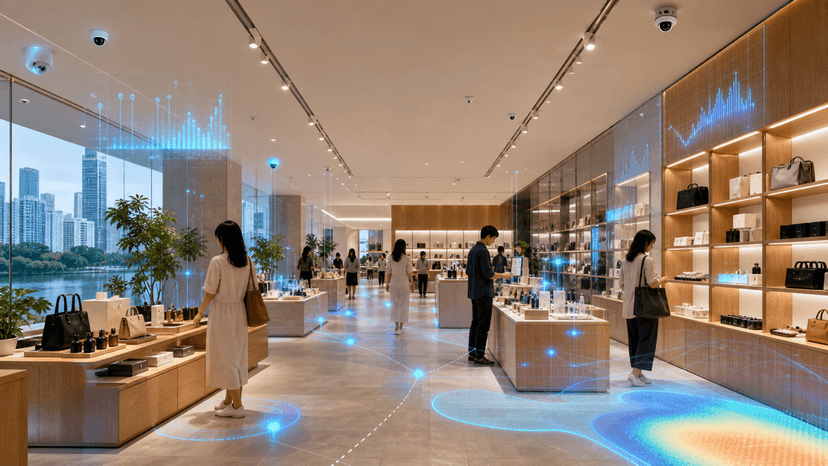
xTrack supports footfall analytics, heatmapping, and AI shopper intelligence. These signals can help retailers understand how customers move through physical spaces and where store performance needs closer attention.
xPilot 3 Pro supports retail network resilience through a 5G SD-WAN failover gateway, with remote management for distributed store environments. For retailers that depend on connected POS, payments, cloud systems, and reporting tools, network resilience is part of operational continuity.
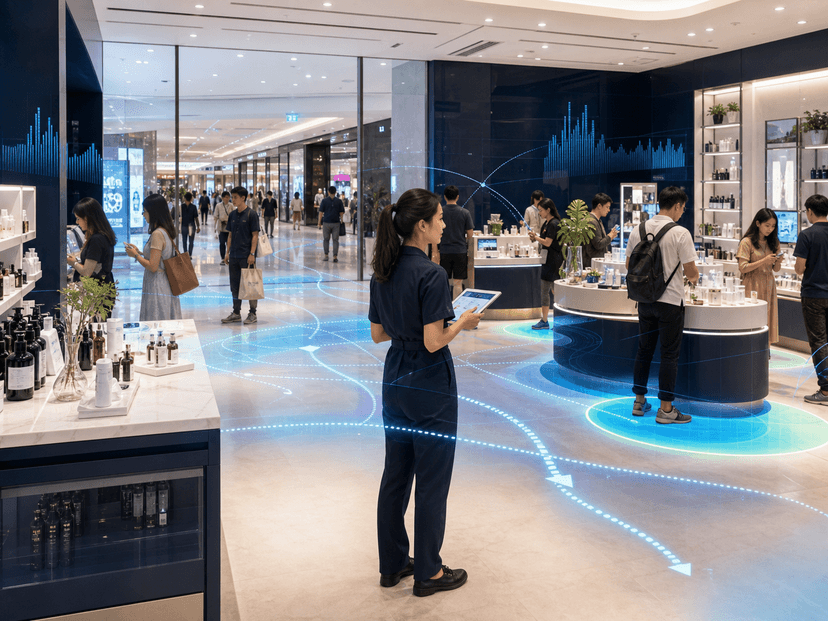
Vortex Cloud provides a unified real-time dashboard for store operations. Its role is to bring operational visibility into one layer so teams can monitor store signals and respond with better context.
The value of this approach is not a claim that one platform solves every retail problem. The value is a more connected operating model: fewer blind spots, clearer store signals, and a stronger foundation for omnichannel execution and AI readiness.
For APAC retailers, that is the shift that matters. The store is no longer just a point of sale. It is a live operating environment connected to digital demand, customer expectations, staff capacity, inventory movement, and network reliability.
Conclusion
Disconnected retail systems create costs that are easy to underestimate because they appear as everyday operational friction. A delayed report. A missed stock issue. A pricing mismatch. A promotion that is not executed consistently. A store team that spends too much time checking systems instead of serving customers. A leadership team that sees performance too late to act.
As Singapore and Southeast Asia retailers continue to balance physical stores with online demand, marketplace activity, social commerce, and AI-assisted operations, the need for connected store architecture becomes more urgent.
The next stage of retail transformation is not only about adding more tools. It is about connecting the right operational signals into one trusted layer so teams can manage stores with speed, clarity, and confidence.
FAQ
Q: What is store disconnection in retail?
A: Store disconnection happens when key retail systems such as POS, inventory, pricing, loyalty, workforce, analytics, and store infrastructure operate separately. This creates gaps in visibility, reporting, and execution across store operations.
Q: Why is disconnected retail technology costly?
A: Disconnected systems increase manual work, delay decision-making, weaken inventory and promotion visibility, and make it harder for teams to respond to store issues quickly. The cost often appears through operational inefficiency, customer friction, and reduced management visibility.
Q: Does a connected store require replacing every legacy system?
A: Not necessarily. A practical connected-store strategy can focus on integrating high-value operational signals into a trusted layer while keeping existing systems where they still work.
Q: Why is connected store architecture important for AI in retail?
A: AI depends on reliable and accessible data. If store signals are fragmented across systems, AI-assisted recommendations may be incomplete or difficult to operationalise. Connected data improves the foundation for AI readiness.
Q: How can APAC retailers start improving store connectivity?
A: Retailers can begin by mapping operational systems, identifying manual reporting gaps, connecting priority signals such as traffic, inventory, promotions, and network status, then building workflows that turn visibility into action.
Explore how xRetail Solutions helps APAC retailers connect store operations, shopper intelligence, and network resilience into a more visible operating layer at www.xretails.com.
Sources
- Deloitte: The connected store, 2026
- KPMG and GS1: Navigating the future of seamless commerce in Asia Pacific, 2024
- Singapore Department of Statistics: Latest Services Data, May 2026
- IMDA and Enterprise Singapore: Retail Industry Digital Plan
- Coresight Research: The State of In-Store Retailing 2025
- Salesforce MuleSoft: 2025 Connectivity Benchmark Report
- Gartner: Retail Digital Transformation CIO Agenda summary
Related Articles
Continue exploring insights from xRetail Solutions

Ready to Transform Your Retail Operations?
Explore how xRetail Solutions connects shopper intelligence, resilient store networks, and unified operations visibility for modern retail teams.
Contact Our Team